
Do an inventory and a venue check before a purchase order. Teams frequently buy items they already have, choose the wrong surface-specific shoes, or order more portable goals than a facility can safely use. A short requirements sheet often prevents more waste than a bulk discount.
Build three lists
Required for participation: appropriate individual player kit, sufficient balls for training, the organiser's uniform requirements and permitted playing venue.
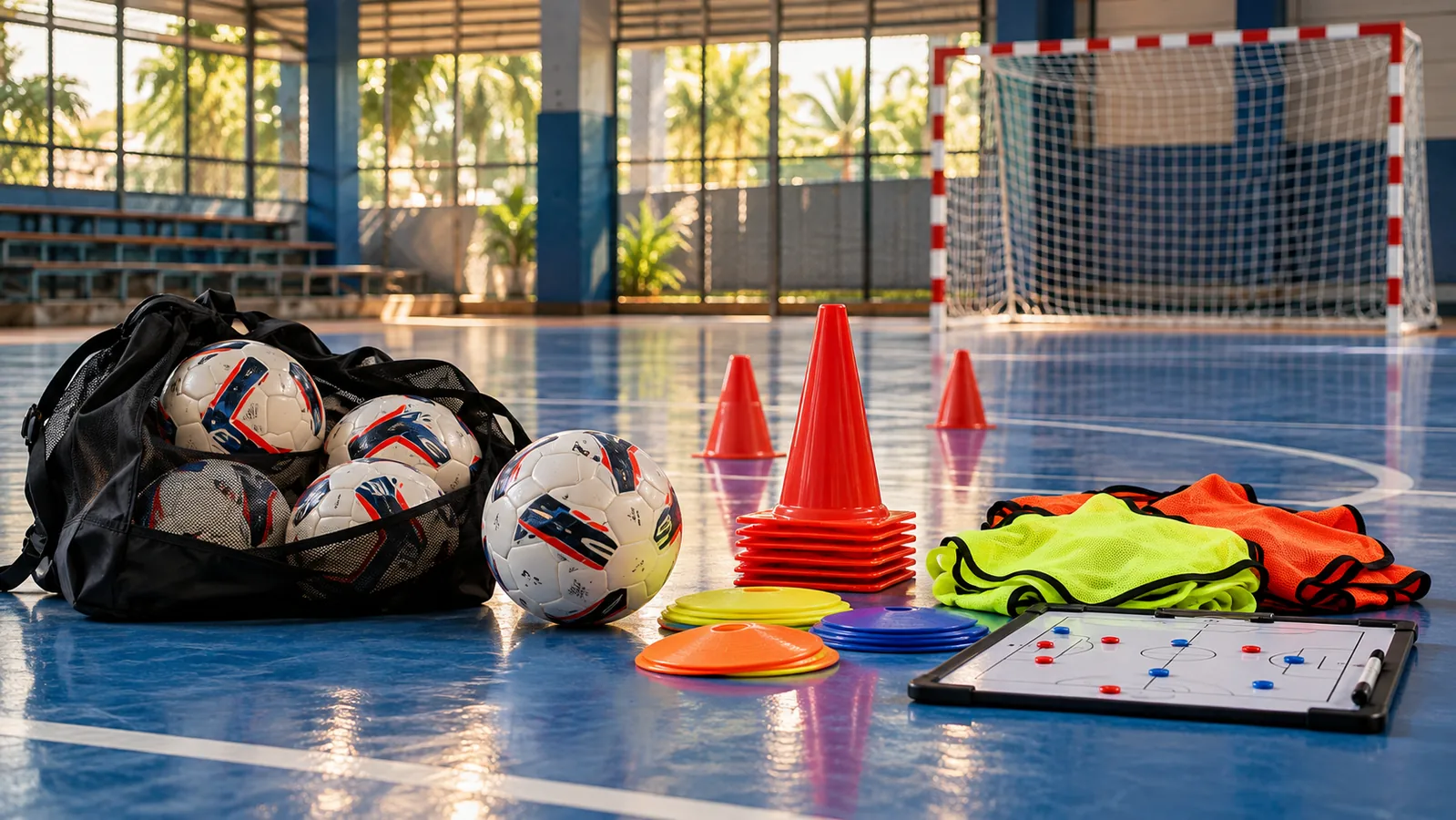
Useful shared training items: coloured bibs, flat markers, spare ball pump, pressure gauge, basic kit bag and first-aid arrangements managed by the responsible organisation.
Conditional upgrades: portable goals, rebound boards, electronic scoreboards and specialist coaching equipment. Each needs a documented training or event use case and a safety/storage plan.
Plan quantities from the programme
Record the number of players, coaches, session groups, ball-to-player ratio needed for your drills and whether balls remain on-site. Avoid a fixed purchasing formula: one age group may use partner drills, another many stations. If you need a rough estimate, record it as your own assumption and recheck after the first sessions.
Goal, net and facility safety
Portable goals can tip or move if improperly secured. Do not purchase a free-standing product on marketing imagery alone; require the facility operator to confirm anchoring, placement, inspection responsibility and any school safety standard that applies. A manufacturer catalogue is not a safety sign-off.
Compare suppliers responsibly
Ask each seller for an itemized quote with model numbers, quantities, shipping region, warranty, lead time and replacement-part policy. Philippine marketplace promotions and bulk pricing fluctuate, so do not copy today's discount into an evergreen guide. Compare landed total cost and repeat replacement expense, not only unit price.
Operational maintenance
Assign a kit custodian, label equipment, maintain a monthly condition check and replace broken or unsafe items. Use a simple shared spreadsheet rather than a new database or app unless the programme grows enough to justify one.
The team-aware equipment planner creates an editable shopping checklist with your own prices and quantity assumptions.
Sources
Verified October 13, 2026 · Freshness: event-driven
- FIFA Futsal Laws of the Game 2025–26, Laws 2 and 4 (official)
- Decathlon Philippines — Football and futsal equipment catalogue (merchant catalogue)