
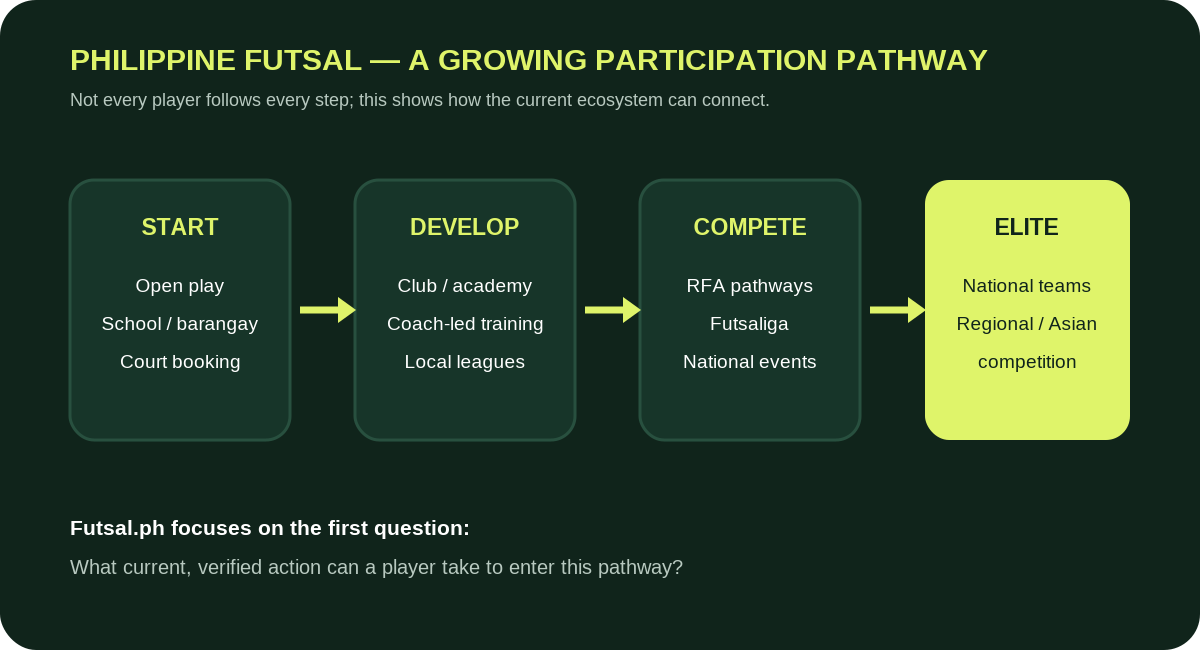
Philippine futsal is entering a more organised phase, but the practical pathway is still fragmented. A player may encounter the sport through a school, barangay clinic, club, academy, open-play group, Regional Football Association (RFA) or national competition.
That fragmentation is why Futsal.ph focuses on current ways to participate instead of trying to maintain a giant historical directory.
The 2025 World Cup created a national spotlight
The Philippines hosted the inaugural FIFA Futsal Women's World Cup in 2025 at Philsports Arena in Pasig. PFF's post-tournament reporting described the event as part of a broader legacy program rather than a one-off international spectacle.
The PFF World Cup legacy report highlights the Filipina5 Futsal Fiesta, which brought regional grassroots teams into the national event experience.
Futsaliga added a national domestic competition
In 2026 the Philippine Football Federation launched PFF Futsaliga, its new domestic futsal competition. The inaugural season brought together youth and adult divisions and used Philsports Arena—the “House of Futsal”—as its central venue.
See the separate PFF Futsaliga guide for the first-season structure and what it does—and does not—mean for somebody looking for a game today.
Grassroots pathways are expanding
PFF's 2026 development program reaches beyond Metro Manila. Its RFA Youth League covers 39 regional associations and includes futsal alongside youth football formats where appropriate.
PFF reported that the RFA Youth League launched in August 2026, with U11 and U13 football and futsal across regional associations through November. In its published example, Maguindanao’s U13 futsal component comprised eight teams. These are competition participation categories, not a national open-registration invitation or proof that a specific academy currently accepts those ages. The PFF report is the source for those claims.
PFF has also supported local futsal clinics and barangay programs, while schools, clubs and private/community organisations run their own leagues and training. GK SipaG Academy is one example with an official inquiry contact; its current session dates and eligibility remain unconfirmed.
This means the practical answer to “where do I start?” depends heavily on location and age. There is no single national registration door for all recreational players.
Coaching is becoming more structured
PFF's current coaching-course pathway includes AFC Futsal Level 1 and Level 2 courses. That matters for long-term development because sustainable futsal growth needs trained coaches as much as courts and tournaments.
Where can you play now?
The Play Finder currently publishes only records with a usable next step: direct booking/registration/attendance or a current inquiry route. Coverage is intentionally incomplete.
Metro Manila currently has the deepest verified set, but the database also includes records in Cebu, Laguna, Bulacan, General Santos, Bukidnon and Davao-area pathways where evidence supports publication.
If you operate a Philippine futsal program that is missing, use Report a change and send a current public source. New coverage is added when it can be verified and maintained.
Sources
Verified October 4, 2026 · Freshness: quarterly
- PFF — A Nation Rising: Moving Philippine Football Forward (official)
- 2026 RFA youth participation and futsal pathway (official)
- PFF — FIFA Futsal Women’s World Cup 2025 legacy (official)
- PFF Futsaliga competition and Philippine futsal ecosystem (official)
- PFF — Coaching courses (official)