
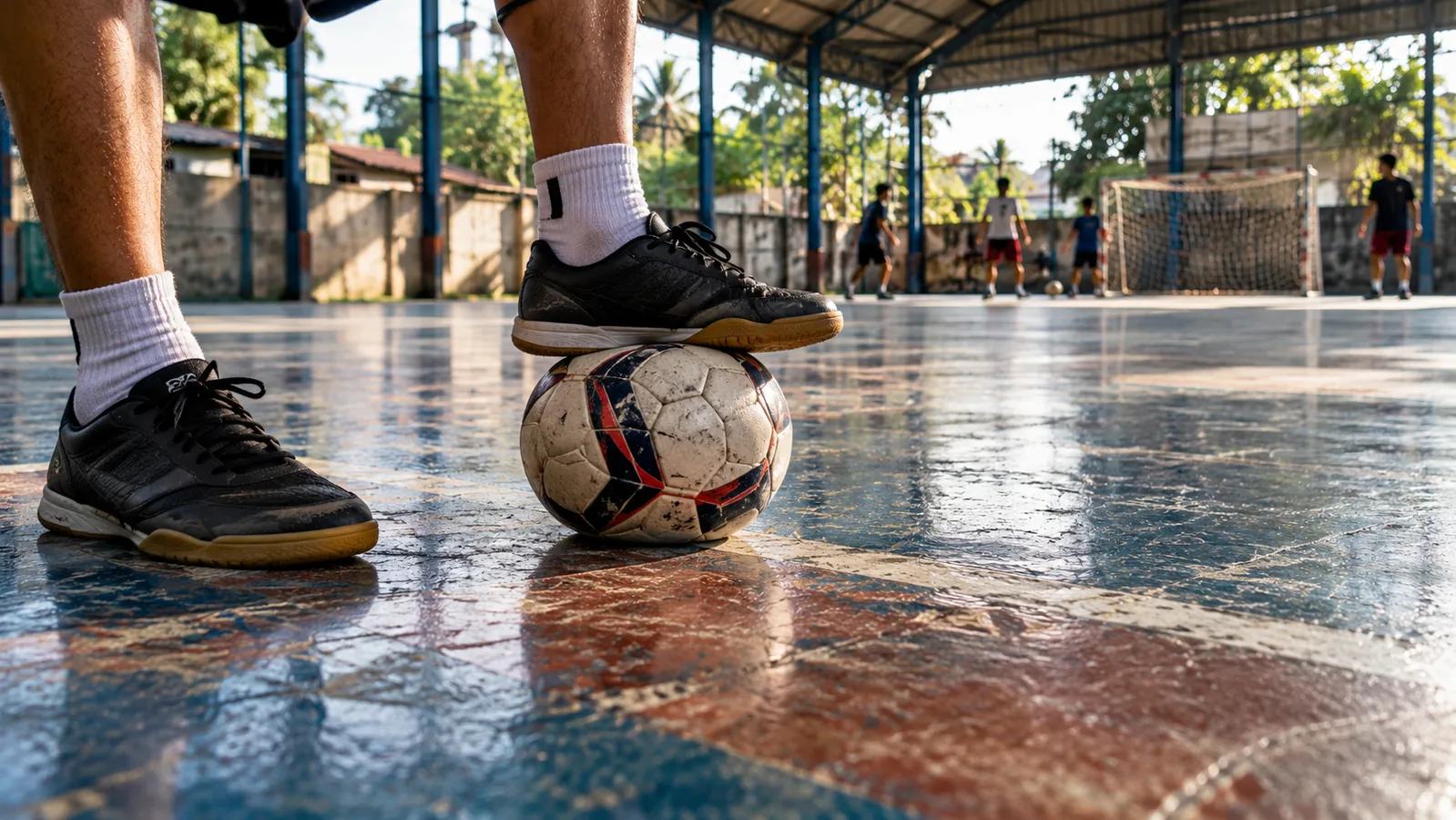
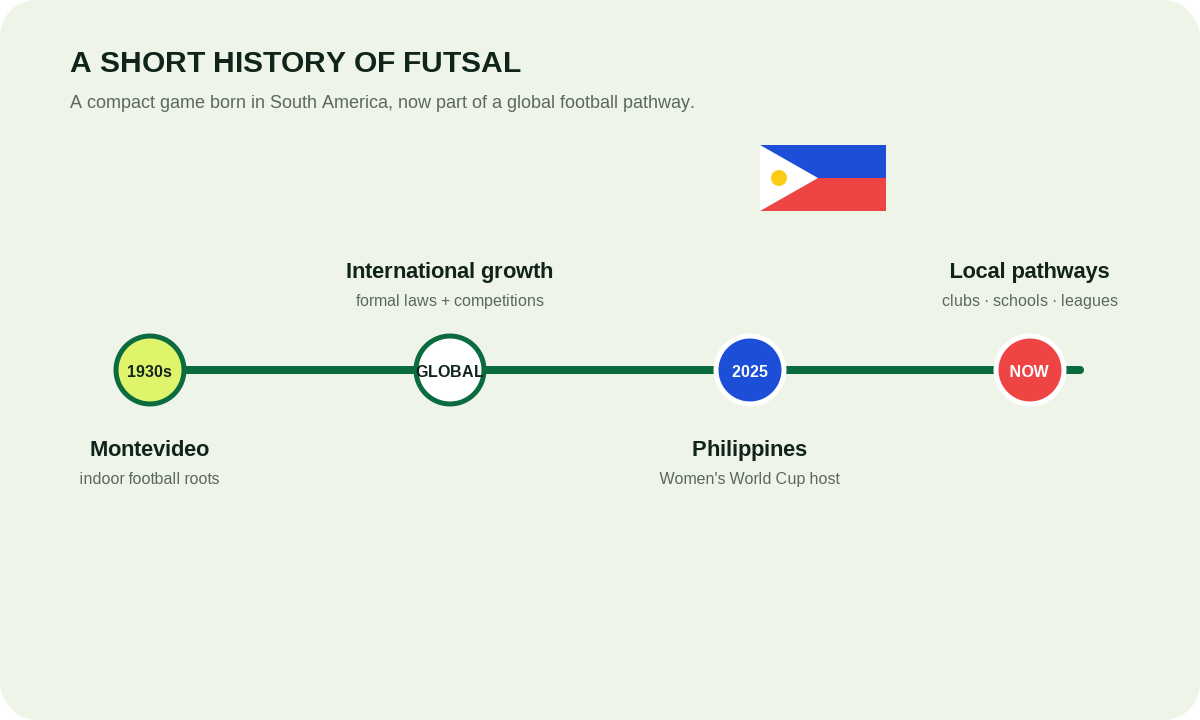
Futsal traces its modern origin to Montevideo, Uruguay, in the early 1930s, where physical-education teacher Juan Carlos Ceriani developed a compact form of football suited to basketball-sized courts.
The historical account is consistent across UEFA's modern futsal explainer and U.S. Futsal's history: Ceriani created a five-a-side game in Uruguay that could function in limited urban space rather than requiring a full football pitch.
1930s: a game designed for compact courts
Ceriani did not simply shrink association football. The early rules borrowed practical ideas from other court sports. UEFA notes that the developing game drew on basketball for five-a-side team size and playing time, handball for court/goal dimensions and water polo for goalkeeper concepts.
That mixed origin helps explain why modern futsal feels different from ordinary “small football.” Its clock, substitutions, court geometry and goalkeeper involvement were built for the compact format.
Growth through South America
The game spread quickly in South America, especially Brazil, where compact-court football became deeply connected to player development and organised competition.
The word futsal later became the common international shorthand derived from terms for indoor/hall football such as fútbol sala and futebol de salão.
From regional game to international sport
International competition developed over subsequent decades before FIFA took responsibility for the globally recognised version of the sport. Today futsal has separate FIFA laws, international tournaments, continental competitions, domestic leagues and specialist coaching pathways.
The important point for beginners is that modern futsal is no longer merely an improvised indoor alternative when a football pitch is unavailable. It is a codified sport with its own technical and tactical identity.
The Philippine chapter
The Philippines has had grassroots futsal activity for years, but recent developments have made the national pathway much more visible. The country hosted the inaugural FIFA Futsal Women's World Cup in 2025, and the PFF launched the first PFF Futsaliga season in 2026.
For that current story, continue with Futsal in the Philippines and What is PFF Futsaliga?.
Sources
Verified October 4, 2026 · Freshness: historical
- UEFA — What is futsal? A beginner’s guide (official)
- U.S. Futsal — History of Futsal (reputable secondary)