
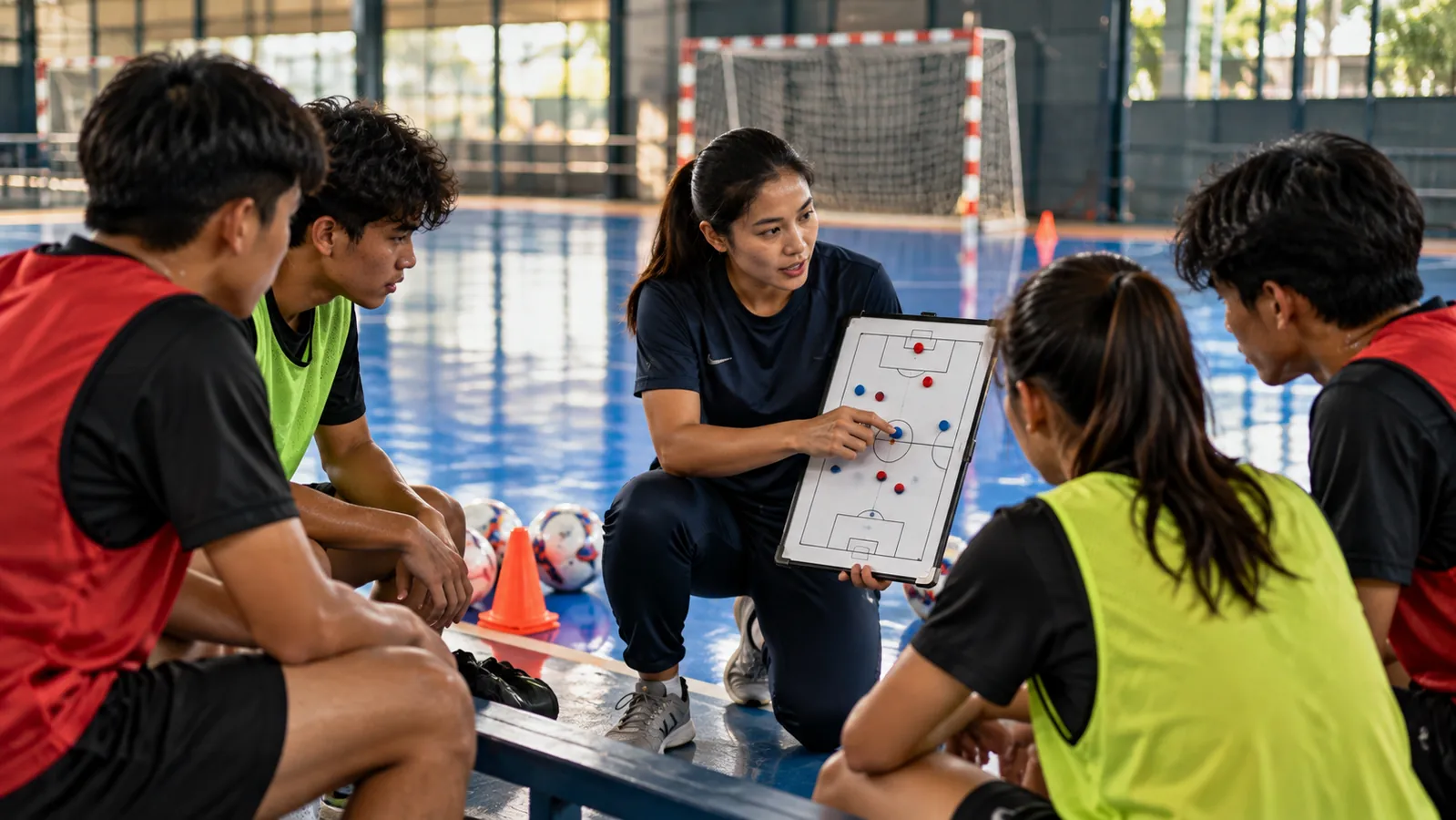
Buy for the training plan, not the size of an equipment catalogue. A coach who already has an appropriate ball set and markers may get more useful sessions from a clear progression than from expensive electronic equipment.
Build from a session plan
Start with the number of players, age group, activity duration, court dimensions and drill transitions. Then decide whether each item actually reduces waiting, improves clarity or allows more ball contact.
| Item | Main job | Lower-cost alternative or buying check |
|---|---|---|
| Reduced-bounce futsal balls | Repetitions, passing and possession drills | Ask whether the venue already provides them |
| Flat discs and cones | Mark stations and small grids | Use existing court lines where safe |
| Two-colour bibs | Change teams quickly | Bring clean contrasting shirts for very small groups |
| Ball pump and gauge | Maintain consistent pressure | Share a reliable club pump |
| Whistle and stopwatch | Keep transitions organised | Use one coach's timer where appropriate |
| Tactics board | Explain rotations without long stoppages | Use a reusable paper court diagram |
Youth and beginner practices
Use age-appropriate balls and respect school/competition regulations. FIFA permits certain adjustments for youth and grassroots futsal; do not treat adult match parameters as mandatory for every beginner programme. Avoid buying portable goals unless their anchoring and safety are addressed by the facility operator.
Storage and upkeep
Label team property, remove damaged balls or sharp cones, and dry equipment after sessions. A bag with compartments can help inventory; it is not essential if equipment is stored safely and consistently.
Purchasing for growth
Test the first four sessions before adding ladders, rebounders, expensive digital boards or specialist accessories. Track which equipment actually gets used. A recurring training programme can then justify quantity purchasing based on observed wear and replacement costs.
Use the school/team equipment checklist when buying for a roster rather than one trainer.
Sources
Verified October 13, 2026 · Freshness: event-driven
- FIFA Futsal Laws of the Game 2025–26, Laws 2 and 4 (official)
- Decathlon Philippines — Football and futsal equipment catalogue (merchant catalogue)