
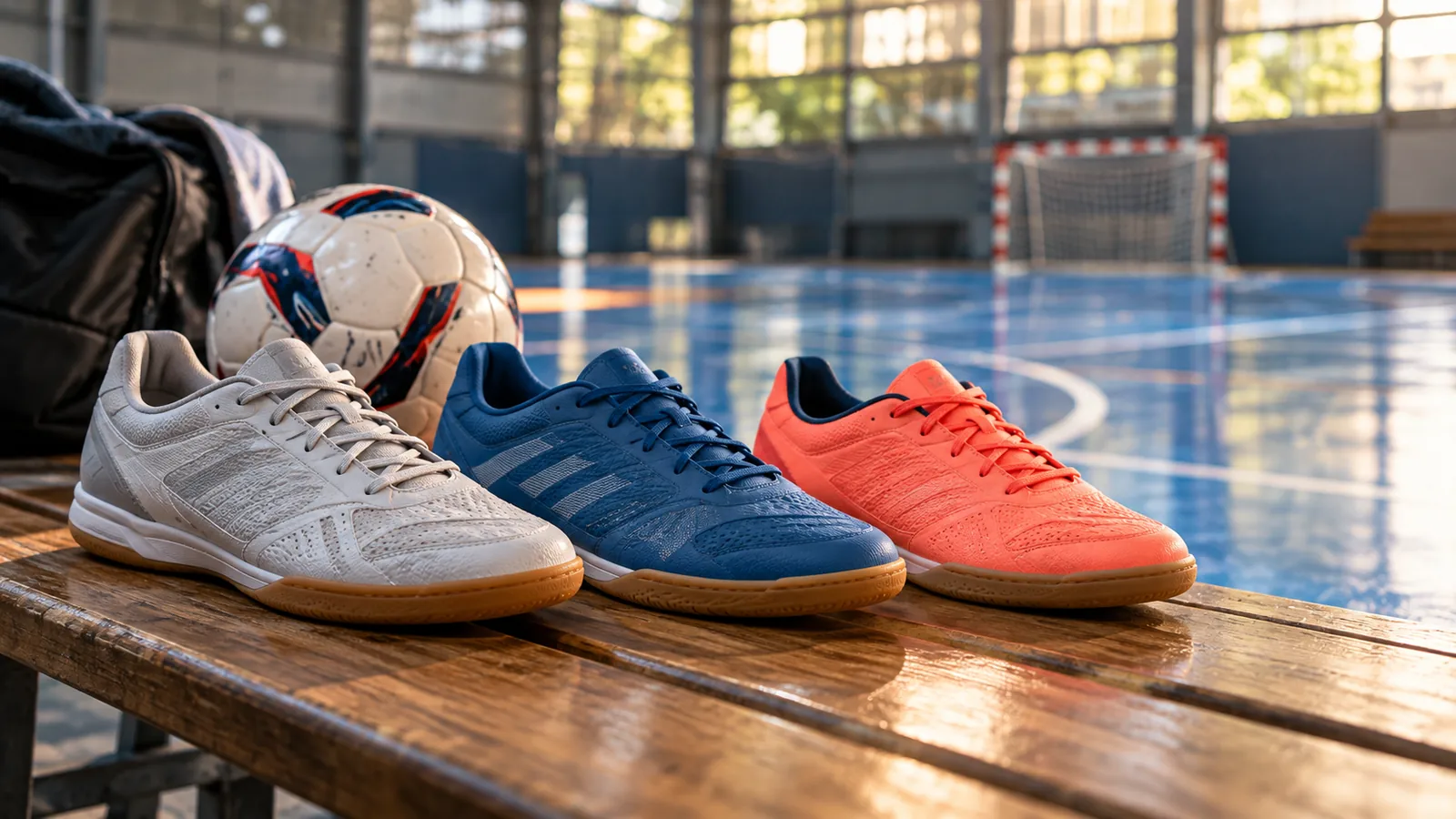
Buy for the floor before you buy for the brand. A smooth indoor futsal court usually calls for a low-profile, flat rubber outsole; a short synthetic turf pitch calls for a different traction pattern. The distinction matters more than the label “football” versus “futsal” on a retailer page. If you do not know the surface, start with the existing court-surface footwear guide.
Four checks before buying
- Outsole: look for an actual indoor or non-marking designation when a school/gym requires it. A shoe marketed for street use is not automatically approved for every wooden court.
- Fit under sideways load: try lateral steps and stop-start movements; the heel should not lift and toes should not be crushed. A size label alone cannot establish fit across brands.
- Cushioning versus court feel: cushioning may matter on unforgiving hard floors, but your movement preference is individual. No brand-level performance advantage can be inferred from product descriptions.
- Use frequency and return policy: frequent players may value replaceable insoles, comfortable lining and durable toe reinforcement. Check current returns before ordering online.
Manufacturer-backed examples, not a ranking
adidas describes the Top Sala Competition 2 with a non-marking rubber outsole, leather forefoot and EVA midsole. Its Super Sala II has a synthetic upper, mesh tongue and non-marking outsole. Nike describes the Tiempo Streetgato for street, court and indoor surfaces but does not establish its non-marking status in the cited specification. None of these claims amounts to an independent wear test. See the model-specification comparison.
What not to buy for indoor futsal
Avoid defaulting to aggressive football studs or turf-specific lugs for a polished sports hall. Equally, do not assume the cheapest flat casual sneaker provides suitable lateral security. Ask the venue about the flooring and shoe policy, then compare actual model specifications rather than retailer popularity badges.
Philippine buying checklist
- Confirm indoor, covered concrete or synthetic turf with the organiser.
- Confirm any non-marking rule.
- Compare your foot length and width with each manufacturer's size chart.
- Save the product code and exact outsole variant; one family can sell IC/IN, TF and FG versions.
- Treat online stock, prices and discounts as changeable—not facts reproduced by this guide.
Next: use the shoe-selection worksheet or read about fit and width.
Two documented indoor-court examples
These are examples to compare against your needs, not ranked recommendations or first-hand tests.
adidas Top Sala Competition 2
- Intended surface
- Smooth indoor courts
- Outsole
- Non-marking rubber
- Upper
- Synthetic upper with leather forefoot
Match fit to your foot; indoor outsole is not designed as turf traction.
Read official specification ↗adidas Super Sala II
- Intended surface
- Smooth indoor courts
- Outsole
- Non-marking rubber
- Upper
- Synthetic upper with mesh tongue
Compare flexibility, comfort and your actual court; current stock is not asserted.
Read official specification ↗Sources
Verified October 13, 2026 · Freshness: quarterly
- adidas Philippines — Top Sala Competition 2 specifications (manufacturer)
- adidas Philippines — Super Sala II indoor specifications (manufacturer)
- Nike Philippines — Tiempo Streetgato official specifications (manufacturer)
- Decathlon Philippines — Football and futsal equipment catalogue (merchant catalogue)