
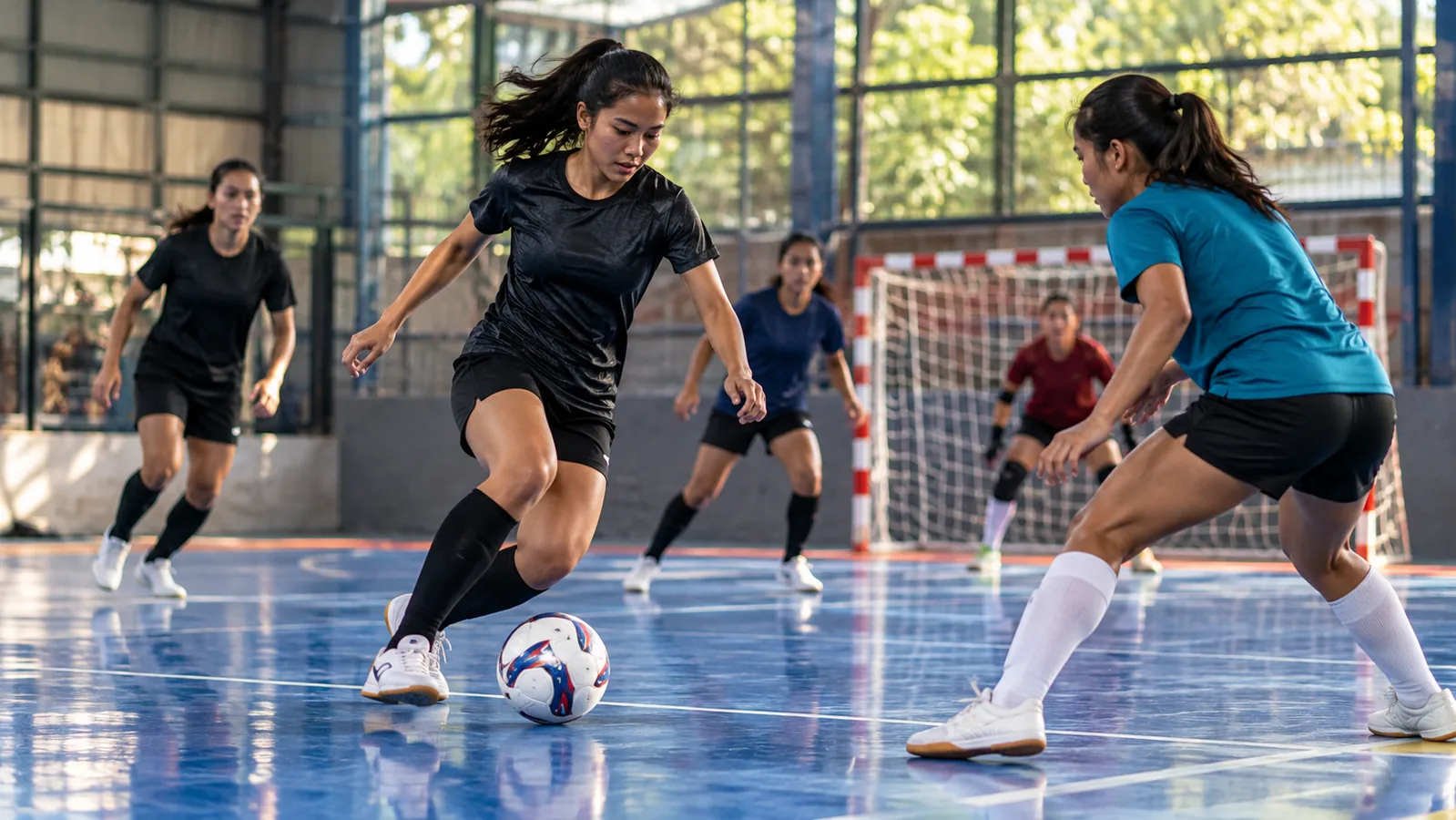
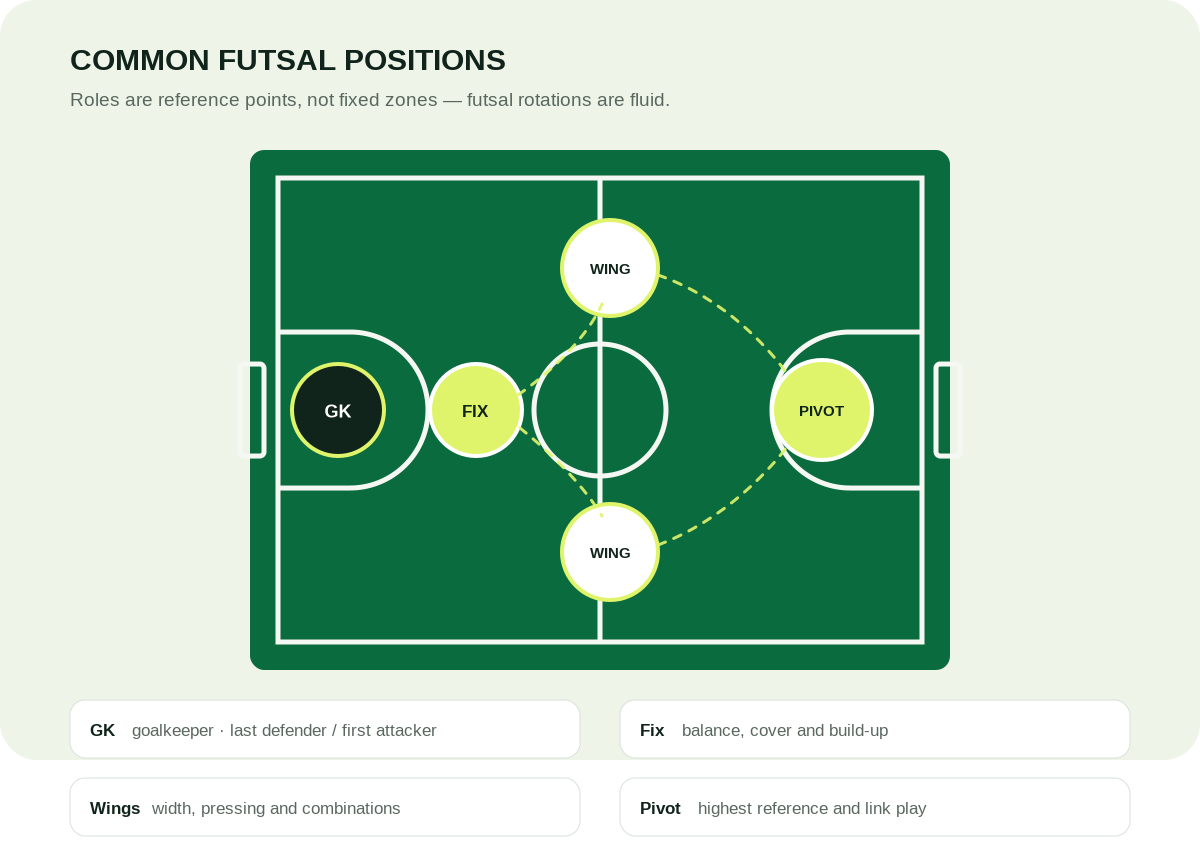
Futsal positions are useful reference roles, not fixed lanes. Because the court is small and the game changes direction quickly, every outfield player should expect to defend, support possession and contribute to attack.
UEFA commonly describes the main roles as goalkeeper, defender/fix, winger and pivot, with some players functioning as universals who can perform several jobs.
Goalkeeper
The goalkeeper protects the goal but is also an important part of possession. On a small court, distribution can start attacks immediately, and advanced teams may use a flying goalkeeper—an outfield player wearing goalkeeper colours—to create an extra passing option.
Beginners should first learn the competition's goalkeeper possession and restart rules before experimenting with power-play tactics.
Fix
The fix (sometimes described simply as the defender) usually operates as the deepest outfield reference. The role often includes:
- organising defensive balance;
- receiving under pressure near the back;
- starting attacks;
- covering teammates who rotate forward;
- controlling the tempo when the team has possession.
A good fix is not merely a centre-back standing near goal. The position frequently moves into attack and must be comfortable receiving with opponents close by.
Wings
Teams normally use two wings as dynamic wide/intermediate players. They provide passing angles, press, carry the ball in one-on-one situations and rotate with the fix and pivot.
Because the court is narrow, “wing” does not mean staying on a touchline. The player may begin wide and then move inside as part of a rotation.
Pivot
The pivot is usually the highest attacking reference. Common responsibilities include:
- receiving with the back to goal;
- protecting the ball under pressure;
- laying passes off to advancing teammates;
- turning to shoot when space opens;
- occupying defenders to create room elsewhere.
Not every formation uses a permanent pivot, but the concept is central to many futsal systems.
Universal
A universal is comfortable performing multiple outfield roles. The term reflects an important truth: good futsal players cannot depend on one fixed position. Rotations can turn a winger into the deepest player and the fix into the highest player within seconds.
Which position should a beginner choose?
Start with the role that suits your current strengths, but learn all four perspectives. Ask a coach to rotate you through different positions rather than defining yourself too early.
If you are looking for structured training, filter the Play Finder for academies or clubs. If you simply want match experience, open play can be a lower-pressure entry point.
From positions to team shape
For coordinated attacking and defensive movement—not individual role definitions—see futsal formations and tactics.
Sources
Verified October 4, 2026 · Freshness: annual
- UEFA — What is futsal? A beginner’s guide (official)
- UEFA — Football vs futsal: the key differences (official)
- England Futsal — What is futsal? (official)