

Formations describe a team's starting relationships, not where four outfield players must stand for the whole match. A futsal side typically defends and attacks as a connected unit. When a player moves, the others adjust for a passing option, central cover or protection against a counterattack.
This page covers the team; the existing futsal positions guide remains the reference for an individual's goalkeeper, fix, wing and pivot responsibilities.
Quick comparison
| Shape | Attacking idea | Strength | Watch for | Starter suitability |
|---|---|---|---|---|
| 2-2 | Two deeper, two higher | Simple passing lines | Gap between lines | Good beginner exercise |
| 3-1 | A higher pivot | Clear forward target | Isolated pivot; weak-side counter | Good when team understands support |
| 4-0 | Continuous rotation with no permanent pivot | Opens moving lanes | Requires coordinated timing | Better after basics |
| 1-2-1 diamond | Fix, two wings, pivot | Triangles and central coverage | Overcrowded centre or exposed wing | Good learning reference, if players rotate |
All images are original schematic starting shapes seen from above, with your team attacking to the right. Numbers represent outfield players only; the goalkeeper remains behind them.
2-2 — two deeper, two higher
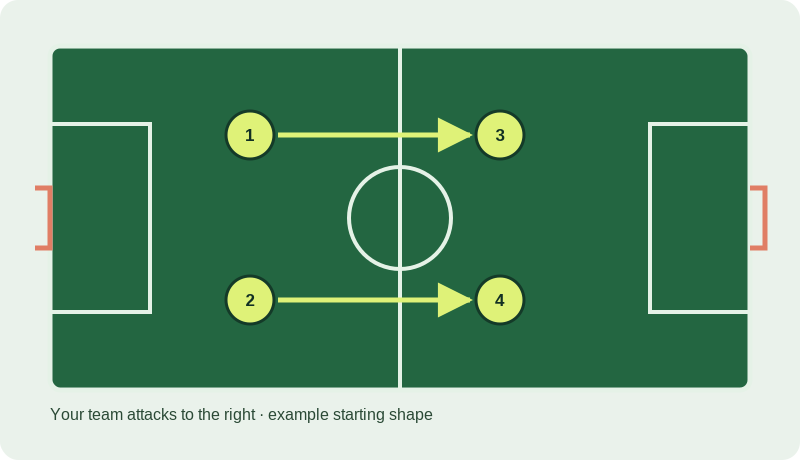
How it works: two players begin near the build-up side and two offer options nearer the opponent. The ball-side deeper player can pass forward or play diagonally. One advanced player checks toward the ball, the other stretches the defence.
Advantages: readily understood; useful for teaching paired support, cover and simple defensive responsibility. Limitations: the middle lane can be empty when the lines separate; flat passing angles invite interceptions. In attack: avoid both advanced players standing in one horizontal line; stagger runs. When defending: the nearest player presses, the others collapse towards central passing lanes. Beginner cue: the far-side deep player protects against the counter when the other steps up.
3-1 — play through a pivot
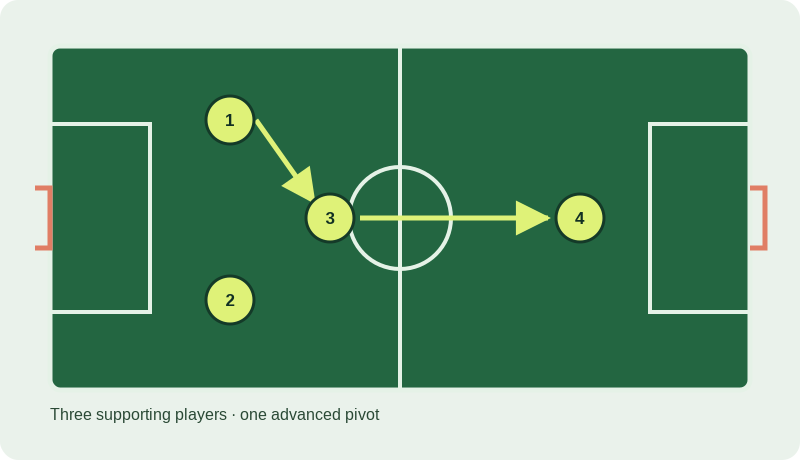
How it works: the deepest three circulate the ball and look for the pivot's hold-up play or a pass into space. The pivot is not required to stand in one location: they can check short, turn, pass back or rotate wide.
Advantages: a clear forward target and useful diagonals. Limitations: easy to force passes into a marked pivot and leave a central hole if a supporting player pushes too soon. In attack: once the pivot lays off, another player may run past while a teammate covers. When defending: recover to a compact structure, rather than keeping three players high. Beginner cue: look for a safe second option before trying the pivot.
4-0 — four moving players, no fixed pivot
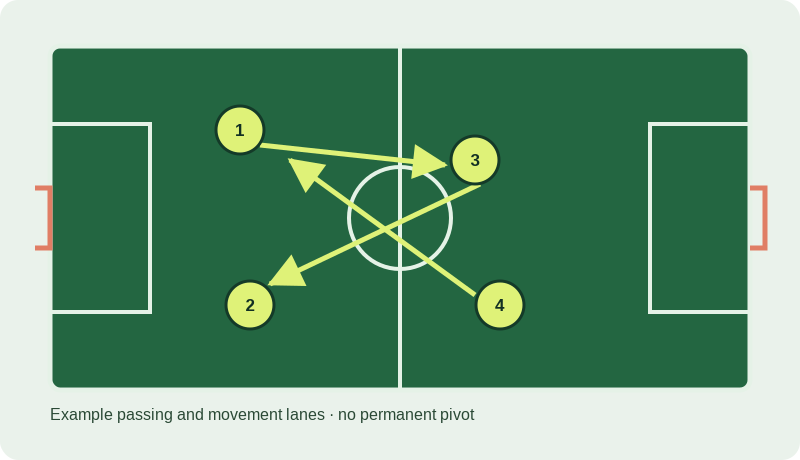
How it works: all four outfield players rotate through space. A pass often triggers a supporting or diagonal run; a teammate fills the lane that was just vacated.
Advantages: hard to mark when timing is good; reduces reliance on one target player. Limitations: requires scanning, accurate passes and cover. If everyone runs forward, one lost pass can expose the goal. In attack: make one movement at a time until coordination improves, then layer runs. When defending: stop rotating and prioritise compact recovery. Beginner cue: master two-player pass-and-move before attempting full 4-0 patterns.
1-2-1 diamond — connected angles
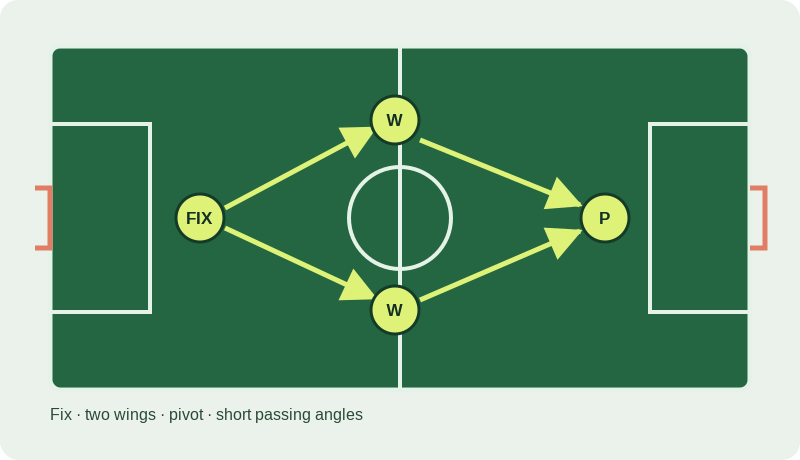
How it works: a deeper fix supports two staggered wings and a higher pivot. Adjacent players create short passing triangles; the far-side player stays available while monitoring defensive cover.
Advantages: easy to visualise support angles; useful for teaching depth and width. Limitations: the team can become narrow if both wings step inside, or too static if everyone protects a designated diamond spot. In attack: a wing can cut inside while the pivot moves wide; another player replaces the vacant space. When defending: the near wing presses or covers, with the deep player protecting the central corridor. Beginner cue: demand a supporting angle from everyone, not a fixed painted position.
How a formation changes during a possession
- Secure the first pass: goalkeeper or deepest player chooses a safe, visible receiving option.
- Create two angles: one teammate comes short, another moves away to stretch the cover.
- Rotate with protection: when a fix or wing runs forward, a teammate temporarily balances behind.
- React to a turnover: nearest player delays; others recover into the middle rather than chasing the ball in a line.
- Reset deliberately: a backward pass is useful when it restores safe spacing and possession.
These are coaching principles, not FIFA laws. Recreational teams can simplify shape and rotations to match their court and skills. Goalkeeper involvement and flying-goalkeeper tactics involve rules and match risks that merit specialised coaching.
Beginner practice: 4v0 shape walk-through
Mark a 10 × 15 m safe rectangle, place four players in a diamond and pass around slowly for 3 minutes. After every pass, the passer moves one step to a different support angle; someone covers the empty space. Pause for 30 seconds and ask who is protecting the centre. Repeat twice, then add one passive defender. This is a practical suggested exercise, not an official set drill.
Use beginner drills to build the first touch and passing required for rotations. A coach can assemble a progression with the training-session planner, while recreational captains can organise playing time with the match rotation planner.
Coaching references
Consult the FIFA Futsal Coaching Manual, including tactics and set pieces and the UEFA Futsal Coaching Manual for deeper study. The diagrams here are simplified original illustrations, not official tactical diagrams.
Sources
Verified October 16, 2026 · Freshness: annual editorial review
- FIFA Futsal Coaching Manual (2025) (official)
- UEFA Futsal Coaching Manual (official)
- FIFA Training Centre Futsal Practice Library (official)