
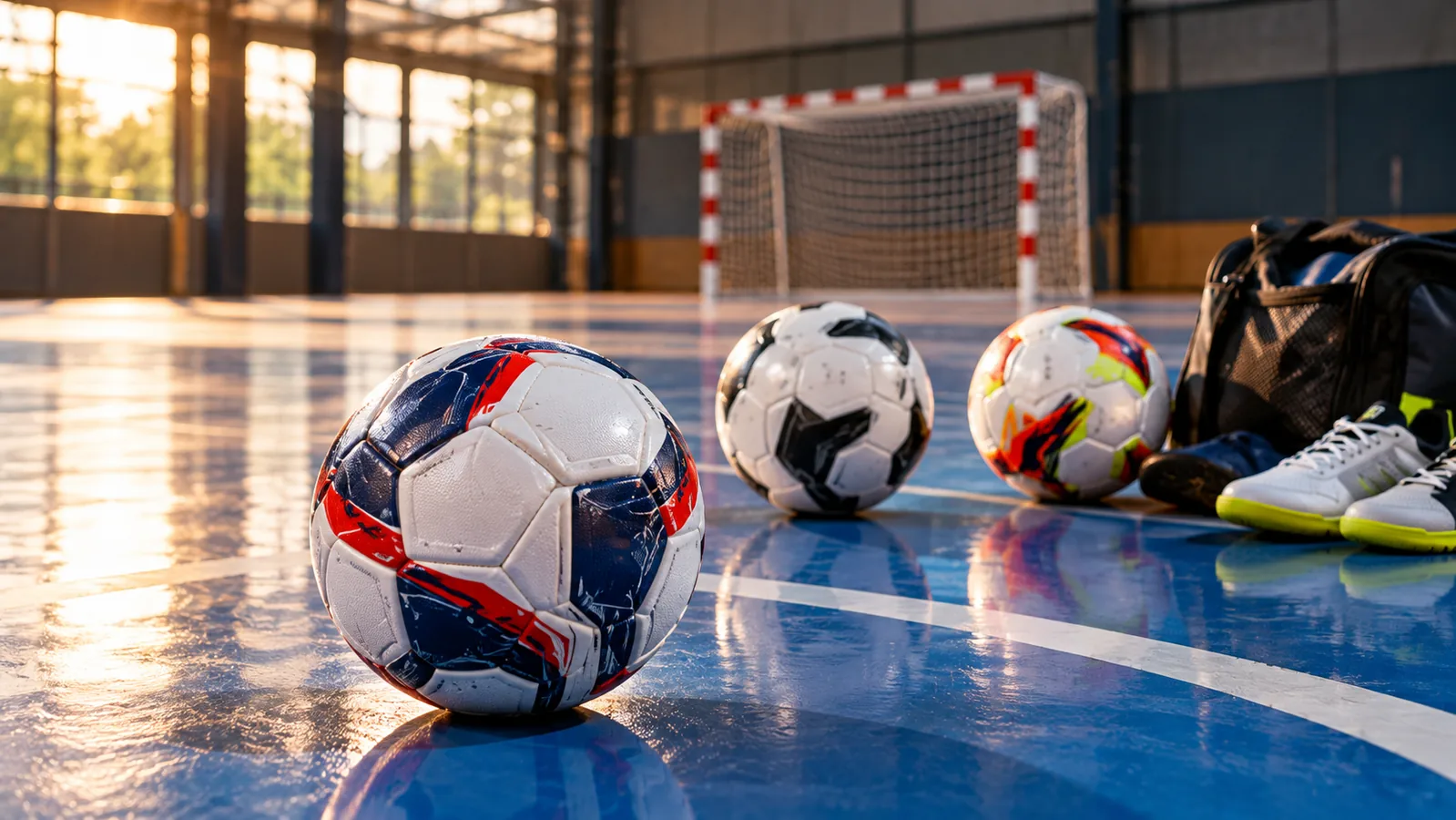
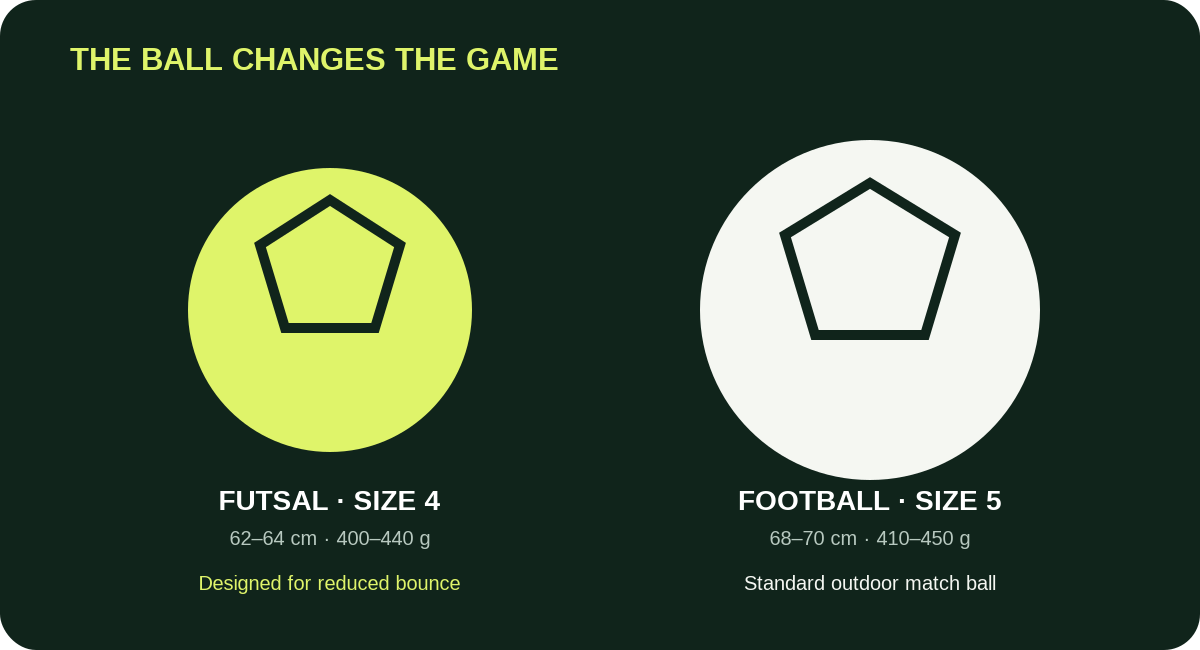
A futsal ball is not simply a small football. The standard senior futsal ball is size 4 with reduced bounce, while the standard adult association-football match ball is size 5.
UEFA describes the futsal ball as smaller, heavier-feeling in play and significantly less bouncy than a standard football. The low-bounce behaviour helps keep the game controllable on a hard court.
Size and weight comparison
| Specification | Standard senior futsal ball | Standard adult football |
|---|---|---|
| Common size label | Size 4 | Size 5 |
| Circumference | 62–64 cm | 68–70 cm |
| Weight at start | 400–440 g | 410–450 g |
| Bounce | Deliberately reduced | Standard football response |
The football dimensions above come from the current IFAB Law 2. For official futsal competition specifications, use the current Futsal Laws of the Game.
Why does the futsal ball bounce less?
On a hard court, an ordinary football can rebound too aggressively. A reduced-bounce futsal ball stays closer to the surface, making close control, fast ground passes and sole-of-the-foot techniques more practical.
That does not mean the ball is dead or soft. It still needs predictable rebound and flight; it is simply designed around a different playing environment.
Is a futsal size 4 the same as a football size 4?
No. The number alone is misleading. “Size 4” can describe different products designed for different games and age groups. Look for an actual futsal ball specification, not only the size number.
Can you use a normal football for futsal?
For an informal kick-around, people sometimes use whatever ball is available. For learning the actual sport or playing organised futsal, use a proper futsal ball. Its bounce characteristics are part of the game.
What should a beginner buy?
Before buying, ask the organizer whether balls are supplied. Many academies, leagues and open-play sessions provide match/training balls, so shoes may be the more urgent purchase.
See What equipment do you need for futsal? and Futsal shoes by surface.
Sources
Verified October 4, 2026 · Freshness: event-driven