
This is a beginner explanation, not a substitute for the rulebook. The current authority is the FIFA Futsal Laws of the Game 2025–26, available through the U.S. Soccer referee-document index. Competition organisers can also use permitted youth/grassroots adaptations.
The short version
Standard futsal is five-a-side, including the goalkeeper, with rolling substitutions and no offside. The match uses kick-ins instead of throw-ins, a stopped clock in standard senior play, four-second limits on important restarts and goalkeeper actions, and an accumulated-foul system that changes the consequence of later fouls.
Players and substitutions
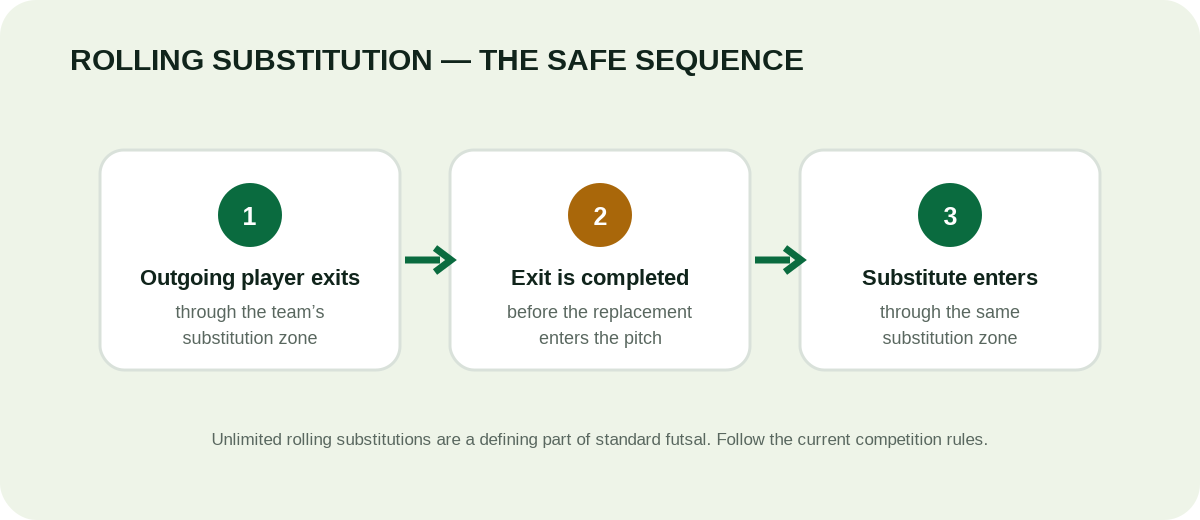
Each team has five players on court, including one goalkeeper. Substitutions are rolling: players can leave and re-enter during the match, subject to the substitution procedure and competition rules.
The practical beginner lesson is simple: do not wander on while the player you are replacing is still on the court. Use your team's substitution zone and follow the official sequence.
Match time
The standard senior game uses two 20-minute periods of stopped time. The timekeeper stops the clock when play is stopped under the laws, so 40 minutes of futsal does not feel like a 40-minute running-clock game.
Local recreational competitions often adapt timing for practical reasons. Ask the organiser which timing format applies.
Kick-ins instead of throw-ins
When the ball crosses a touchline, futsal restarts with a kick-in. The ball is placed for the kick rather than thrown overhead.
This encourages fast ground restarts and is one reason futsal can feel continuous even when the ball repeatedly leaves the narrow court.
The four-second rule
Four-second counts apply to several situations. Beginners notice them most on kick-ins, corners, free kicks and goalkeeper possession/restarts. The purpose is to prevent delay and keep the game moving.
Do not treat “four seconds” as one universal goalkeeper rule for every possible situation—the full law contains details about location, possession and restarts.
No offside
Futsal has no offside law. A pivot can therefore operate high up the court, but the compact space means simply standing near goal rarely creates easy chances: passing lanes and rotations still matter.
Accumulated fouls
Certain direct-free-kick fouls are accumulated by each team within a period. Once the threshold is reached, later accumulated fouls can produce direct free kicks without the normal defensive wall conditions.
This changes late-period defending. A challenge that looks ordinary early in a half can carry a much greater tactical cost when the team is already on five accumulated fouls.
Goalkeeper involvement
The goalkeeper is often far more involved in possession than a beginner expects. Distribution, pressing resistance and the flying goalkeeper tactic can make the keeper an active part of attack.
The goalkeeper also faces specific four-second and possession restrictions, so football goalkeeper habits do not transfer perfectly.
What should you learn first?
For a first recreational session, focus on:
- kick-ins;
- substitution procedure;
- four-second restarts;
- no offside;
- respecting accumulated-foul situations;
- the organiser's local timing and goalkeeper rules.
Then learn the complete laws as your competition level rises.
See Futsal vs football, Futsal positions and the Play Finder.
For social matches and scorekeepers
Use the printable futsal match sheet to record rosters, goals and fouls. The worksheet does not replace official refereeing or current laws.
Sources
Verified October 4, 2026 · Freshness: event-driven
- U.S. Soccer Refereeing Documents — Futsal Laws of the Game 2025-26 (official)
- UEFA — What is futsal? A beginner’s guide (official)
- England Futsal — What is futsal? (official)