

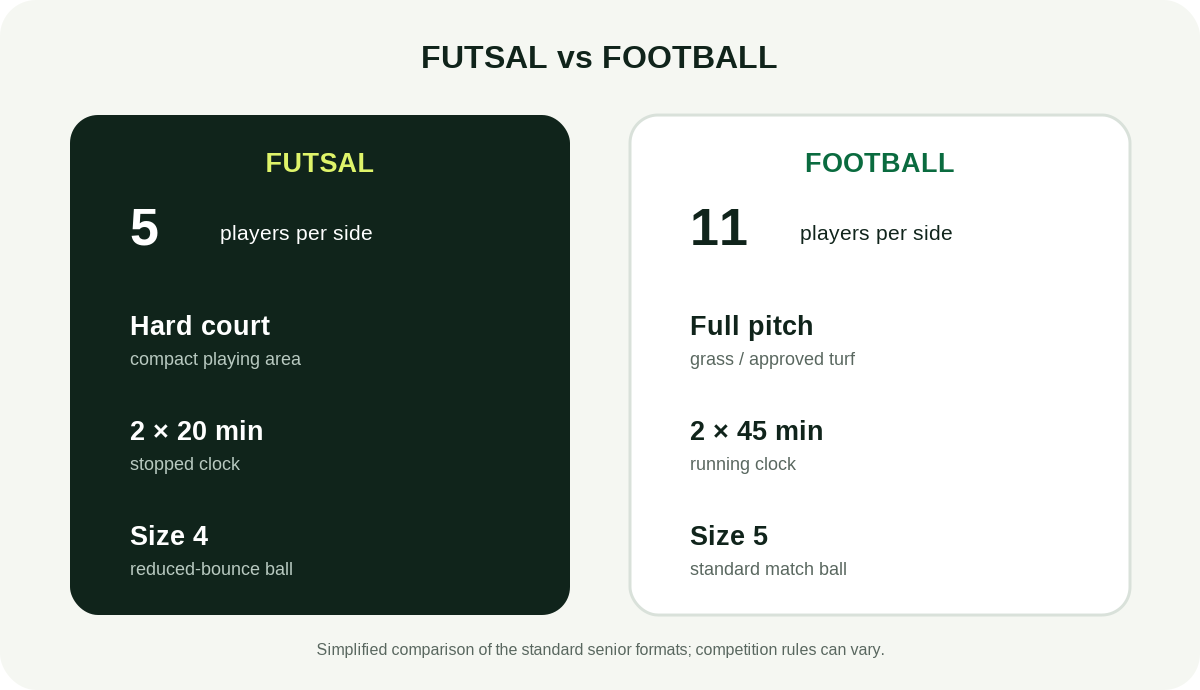
Futsal and football share the same basic objective—use the feet and body to move a ball into the opponent's goal—but the standard games are structurally different.
The most useful comparison is not “indoor versus outdoor.” It is small hard-court futsal with its own laws versus 11-a-side association football under the IFAB Laws of the Game. UEFA's current football-versus-futsal explainer is a good authoritative starting point.
Futsal vs football at a glance
| Feature | Futsal | Football |
|---|---|---|
| Players on court/pitch | 5 per side including goalkeeper | 11 per side including goalkeeper |
| Standard senior match | 2 × 20 minutes, stopped clock | 2 × 45 minutes, running clock |
| Substitutions | Rolling and unlimited under standard futsal rules | Limited substitutions under competition rules |
| Ball | Size 4, reduced bounce | Standard adult size 5 |
| Surface | Flat hard futsal surface | Natural or approved artificial turf |
| Offside | None | Yes |
| Sideline restart | Kick-in | Throw-in |
| Team foul count | Accumulated fouls affect later direct free kicks | No equivalent accumulated-foul mechanism |
| Typical space per player | Much smaller | Much larger |
Competition details can vary, particularly in youth and grassroots play, so the table is a standard-format comparison rather than a substitute for the applicable rules.
Space and decision-making
Futsal compresses ten players into a much smaller playing area. The practical effect is less time before pressure arrives. First touch, body position, scanning and support angles become immediately important.
Football gives players more space to stretch opponents horizontally and vertically, use longer passes and manage larger transition distances. The physical and tactical demands are different rather than simply “harder” or “easier.”
The ball changes the game
A senior futsal ball is typically size 4 and designed for reduced bounce. A senior football is size 5; the current IFAB Law 2 specifies 68–70 cm circumference and 410–450 g for the standard football match ball.
That difference helps keep futsal grounded and controllable on a hard surface. See the dedicated futsal ball vs football ball guide for the practical buying implications.
Substitutions and intensity
Futsal uses rolling substitutions. Players can rotate repeatedly rather than waiting for a formal stoppage and being permanently replaced. That supports frequent high-intensity efforts and tactical changes.
Football substitutions are far more limited and usually occur during stopped play. A football player therefore manages a much longer continuous workload and greater total distance.
Restarts, offside and fouls
Three rule differences quickly change how a beginner experiences futsal:
- the ball comes back from the sideline with a kick-in, not a throw;
- there is no offside;
- direct-free-kick fouls are accumulated by team within a period, creating stronger consequences after the threshold is reached.
Futsal also places four-second limits on several restarts and goalkeeper situations, discouraging delay and keeping the game moving.
Positions are more fluid
Football has eleven-player formations with specialised lines and roles. Futsal usually describes four primary roles—goalkeeper, fix, wings and pivot—but the outfield positions rotate constantly.
See Futsal positions explained for a practical court diagram.
Which should you play?
You do not have to choose permanently. Futsal suits players who enjoy frequent touches, compact combinations and fast changes between attack and defence. Football offers the spacing, running demands and tactical structures of the full-sized game.
If you want to experience the difference directly, find a current futsal opportunity instead of trying to recreate futsal with ordinary football rules on any available indoor field.
Practise futsal-specific movement
The beginner drills and formation diagrams demonstrate how small-sided movement changes in a compact court.
Sources
Verified October 4, 2026 · Freshness: annual + event-driven rules check
- UEFA — Football vs futsal: the key differences (official)
- UEFA — What is futsal? A beginner’s guide (official)
- IFAB Laws of the Game — current Law 2: The Ball (official)
- Nivia Sports — Futsal vs football comparison (manufacturer)