
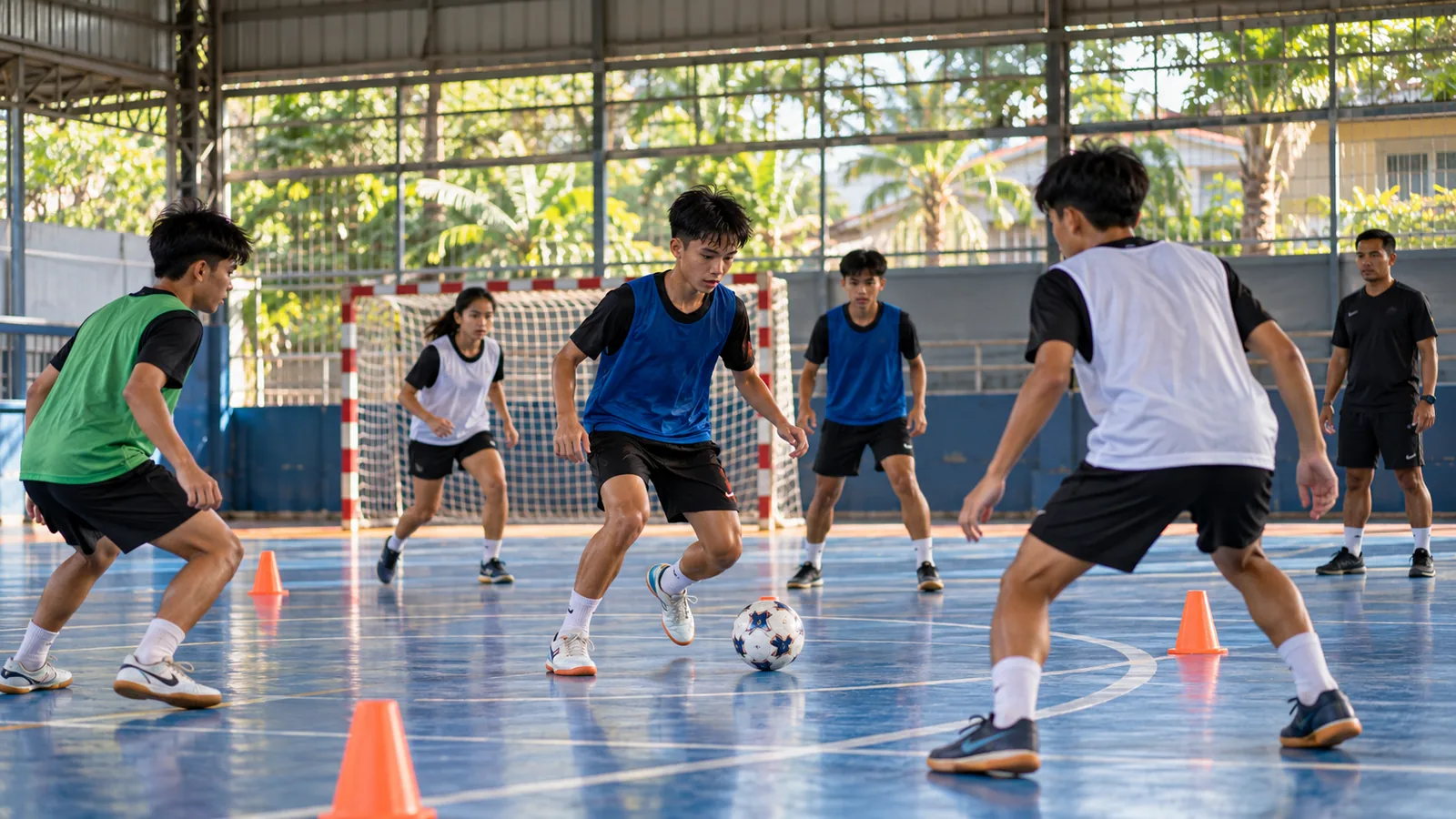
Start with a ball, a safe patch of court and short repetitions—not complicated equipment. These eight drills are designed for a barangay covered court, school gym or shared futsal hall. The times and repetitions are suggested recreational starting points, not official FIFA training requirements. Adjust for age, ability, floor grip, heat and available space. Stop an exercise if pain or unsafe conditions occur.
You need: ideally a futsal ball per player or pair, four to eight markers (cones, tape or safe flat objects), a wall or partner, drinking water and appropriate shoes. Check that you are not blocking another game, exits or exposed goal frames. Avoid shooting toward bystanders.
Choose a drill by skill and group size
| Drill | Level | Players | Setup | Starting dose |
|---|---|---|---|---|
| 1. Sole-touch ladder | Beginner | 1+ | Ball; 2 × 2 m | 3 × 30 seconds |
| 2. First-touch gate | Beginner | 1–2 | Two marker gates; 4 × 6 m | 10 receives each foot |
| 3. Passing triangles | Beginner–intermediate | 3 | Three cones 3–5 m apart | 3 × 90 seconds |
| 4. Tight-lane dribble | Beginner | 1+ | 4 cones; 2 × 8 m lane | 5 runs each foot |
| 5. Turn and escape | Intermediate | 2 | 4 × 4 m square | 6 turns each way |
| 6. Pass, follow, finish | Beginner–intermediate | 2–4 | Small safe goal or target | 8 shots each |
| 7. Delay and angle | Beginner | 2 | 4 × 6 m square | 5 × 30 seconds |
| 8. Two-goal transition | Intermediate | 4–6 | 10 × 15 m small-sided area | 3 × 2 minutes |
Distances are approximate. Reduce speed and space when starting, then increase pressure as control improves.
1. Sole-touch ladder — become comfortable with the ball
Purpose: controlled contacts with both feet, balance, and keeping the ball within one step. Set-up: each player stands with a ball on a flat, dry surface. Do: gently roll the ball side to side under one sole for 15 seconds, switch feet, then alternate soles in place. Repeat three 30-second sets with 20–30 seconds to recover. Keep your eyes up briefly between touches. Easier: stationary toe taps at walking pace. Harder: travel through a narrow lane without allowing the ball outside it.
2. First-touch gate — receive into space
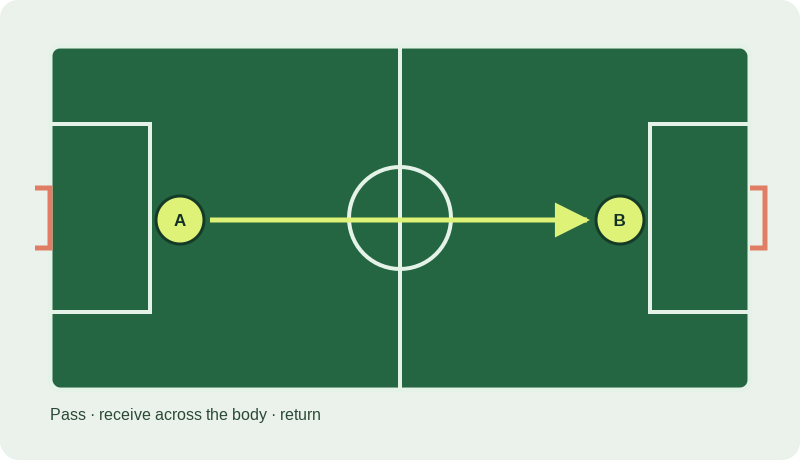
Purpose: move the ball away from pressure with the first touch. Set-up: make two gates 1–2 m apart. A partner passes from roughly 3–5 m away, or use a safe wall rebound. Do: open your hips, receive across your body using the inside or sole, guide the ball through one gate, return the pass. Try 10 controlled receives on each foot. Easier: stop the ball before moving it. Harder: alternate gates on the pass, decided by a partner's signal. Watch the next space before the ball arrives.
3. Passing triangles — pass and move
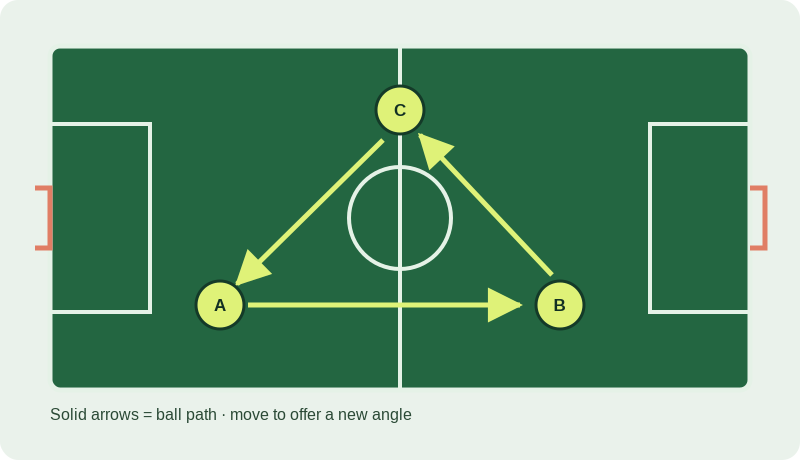
Purpose: play the ball accurately and offer a new angle. Set-up: three cones in a triangle roughly 3–5 m apart, one player at each point. Do: pass to the next player, step off the line and take the receiving player's former position on a slow rotation, or keep positions fixed for the first round. Run three 90-second rounds, with 30-second breaks. Easier: allow a controlled second touch. Harder: add a passive defender to block one passing lane. A triangle is about available support—not a fixed match formation.
4. Tight-lane dribble — keep touches small
Purpose: change direction without losing the ball. Set-up: four cones along an 8 m lane, spaced about 2 m apart, with enough distance between lanes. Do: dribble through markers using short inside/outside-foot touches. Walk back for recovery. Try five runs leading with each foot. Easier: widen the slalom. Harder: use the weaker foot or raise your head at each cone. Prioritise control over sprint speed.
5. Turn and escape — protect the ball
Purpose: control, shield and turn under moderate pressure. Set-up: a 4 × 4 m square and one passive defender. Do: the attacker receives, briefly shields, uses a sole-pull or inside turn and dribbles to a free side. Try six turns to each side, then swap roles. Easier: no defender. Harder: allow controlled 50% pressure. The defender must not tackle from behind or shove.
6. Pass, follow, finish — shoot after moving
Purpose: practise a pass into space, supporting run and accurate finish. Set-up: a safe, small goal or clearly marked wall target with no bystanders. Do: player A passes to B, moves to a new angle for a return ball, sets a controlled first touch and shoots. Take eight shots each, changing shooting foot. Easier: static ball near goal. Harder: add a recovering defender. Use the goal's size appropriate to your space; do not imitate official goal dimensions in an unsafe venue.
7. Delay and angle — defend without lunging
Purpose: slow an attacker, direct them away from the central lane and stay balanced. Set-up: a 4 × 6 m channel with a finish line. Do: defender begins 1–2 m from the attacker, bends knees, stays side-on, retreats to block the straight route and waits for a poor touch. Defend for five 30-second turns, swapping each round. Easier: walking-speed attacker. Harder: allow a genuine controlled interception. Avoid contact, slide tackles and unsafe surfaces.
8. Two-goal transition — practise real decisions
Purpose: switch quickly between attack and defence. Set-up: two small safe targets on a 10 × 15 m court section; play 2v2 or 3v3. Do: a point is scored by passing/dribbling through a target or with a controlled shot. After losing possession, the nearest defender immediately slows the attack while others recover. Play three 2-minute rounds, with 1-minute pauses. Easier: start without goals and count five successful passes. Harder: limit touches only when players have control. Keep a buffer around walls and posts.
Complete 20-minute beginner practice routine
| Minutes | Activity | Practical objective |
|---|---|---|
| 0–3 | Progressive movement and gentle sole touches | Warm up; assess court grip |
| 3–6 | First-touch gate | Receive into space with each foot |
| 6–10 | Passing triangles or paired passes | Support and accurate passing |
| 10–13 | Tight-lane dribble | Control while changing direction |
| 13–16 | Pass, follow, finish | Controlled shot after movement |
| 16–19 | Small 2v2 transition or delay-and-angle drill | Put skills into simple decisions |
| 19–20 | Walk, recover, quick review | Hydrate and name one next improvement |
For a solo session, replace passing triangles with safe wall returns and the 2v2 game with sole-pulls, turns and target passes. For very young players, use shorter activities, more rest and a fun ball game; this is not a prescribed medical or youth conditioning programme.
Common coaching cues
- Eyes up between touches: scan for the next decision, not permanently at the ball.
- Pass then move: create an angle instead of admiring the pass.
- Use both feet: alternate without sacrificing accurate technique.
- Control first, then pressure: increase difficulty only after success at slow speed.
- Everyone participates: avoid long static queues with one ball and one active player.
- Respect venue constraints: available space, surfaces, heat and organiser rules come first.
Next steps
Use the training session planner to fit these drills into a 30-, 45- or 60-minute coaching session. To understand how several players work together, read futsal formations and tactics; for individual roles, use the existing positions guide. Find a real class or game through the Play Finder.
Editorial basis
This guide adapts broad beginner training principles rather than reproducing proprietary drill materials. See the FIFA Futsal Coaching Manual, the FIFA Training Centre futsal practice library, and the UEFA Futsal Coaching Manual. Repetitions and drill layouts are Futsal.ph suggestions, not official prescriptions.
Sources
Verified October 16, 2026 · Freshness: annual editorial review
- FIFA Futsal Coaching Manual (2025) (official)
- UEFA Futsal Coaching Manual (official)
- FIFA Training Centre Futsal Practice Library (official)