
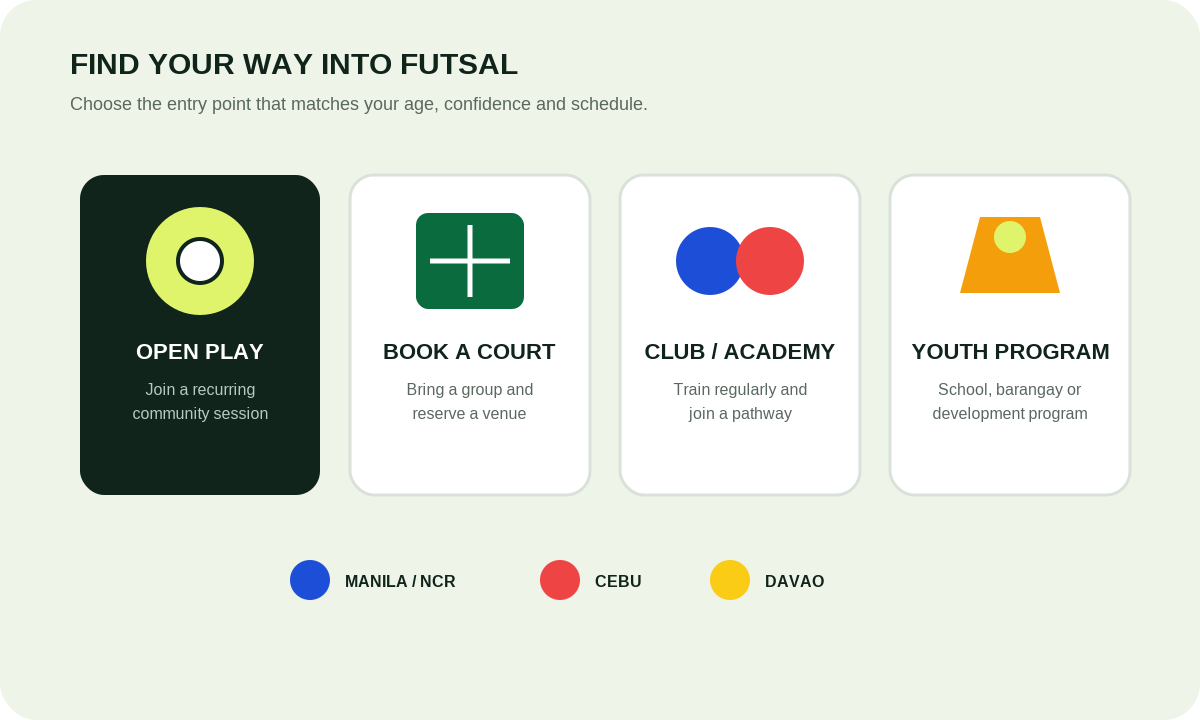
Starting futsal is usually less about memorising every rule and more about finding the right entry point. In the Philippines that entry point may be open play, a court booking with friends, a grassroots club, a youth program, an academy or an organised league.
1. Choose the easiest next action
Use the Play Finder and decide what you actually need:
- Book — you already have players and need a court;
- Attend — you want recurring open play;
- Join — you want a club/community;
- Register — you found an active intake or league form;
- Inquire — the organisation is active but changing details need confirmation.
Futsal.ph deliberately separates those states so a historical venue is not presented as if it accepts walk-ins today.
2. If you are a beginner, say so
When contacting an organiser, include:
- your age;
- approximate experience level;
- whether you are alone or bringing a group;
- your location;
- the date/session you are asking about.
A club with a competitive Futsaliga team may also run beginner sessions—but that should be confirmed rather than assumed.
3. Ask three questions before travelling
- Is the session definitely happening on the date I plan to go?
- Is it open to my age and level?
- What shoes are allowed on the actual surface?
Schedules and available slots change faster than addresses. That is why the Finder shows last-verified dates and source/contact links.
4. Bring only the basic kit first
For a first session, start with comfortable sports clothing, water and surface-appropriate shoes. Ask whether the organiser provides balls and whether shin guards are required.
See Futsal ball vs football ball, shoes by surface and the basic equipment checklist.
5. Learn the rules you will notice immediately
Before the first game, understand:
- five-a-side teams;
- rolling substitutions;
- kick-ins;
- no offside;
- the four-second concept;
- accumulated fouls.
The beginner rules guide explains those without turning the page into a rewritten rulebook.
6. Look for a development pathway if you want more than pickup games
PFF's recent grassroots programs and RFA competitions show a growing structured pathway around youth futsal. Clubs, academies and school/community programs can provide more regular coaching than casual open play.
Read Futsal in the Philippines for the broader ecosystem and Futsal positions once you begin structured training.
For parents considering community programs: GK SipaG Academy’s futsal pathway is an example of a verified organization with an inquiry route—but no confirmed recurring Sunday session or current U11/U13 admission. Ask the organizer directly before attending.
7. Help keep the database useful
If you arrive and discover that a listing is closed, full, moved or using a different schedule, use Report a change. Futsal.ph does not auto-publish corrections; reports are reviewed against evidence first.
Organise your own recreation game
If you already have players and a suitable space, use the match rotation planner for fair playing-time blocks. If you are coaching beginners, start with the training session planner.
Sources
Verified October 4, 2026 · Freshness: quarterly + event-driven rules check